Demystifying Goods and Services Tax (GST)
Explore the core principles of GST, its impact on businesses, and effective methods for calculating it using online resources.
Companiesinn
Created: 16th July, 2025 3:39 PM, last update:16th July, 2025 3:39 PM
Article Content
Understanding Goods and Services Tax (GST)
Goods and Services Tax, often abbreviated as GST, is a pivotal element of India's taxation framework. It was introduced on July 1, 2017, to consolidate various indirect taxes into a single, more efficient system. GST is applied to the supply of goods and services and is charged at every stage of the production and distribution chain, ensuring tax is collected at the point of consumption.
What is GST?
GST aims to simplify the tax structure and is divided into five tax slabs: 0%, 5%, 12%, 18%, and 28%. Certain goods, such as petroleum products and alcohol, are exempt from GST, allowing state governments to impose their own taxes on these items. This system not only promotes compliance but also mitigates the cascading effect of taxes, ultimately benefiting consumers through reduced prices.
Types of GST
GST is categorized into four primary types:
- Central Goods and Services Tax (CGST): Collected by the central government on sales within a state.
- State Goods and Services Tax (SGST): Collected by state governments on intra-state transactions.
- Union Territory Goods and Services Tax (UTGST): Applicable in Union Territories.
- Integrated Goods and Services Tax (IGST): Imposed on inter-state sales, facilitating the smooth movement of goods across state lines.
For transactions occurring within a single state, both CGST and SGST are applicable. Conversely, IGST governs transactions that cross state borders.
What is a GST Calculator?
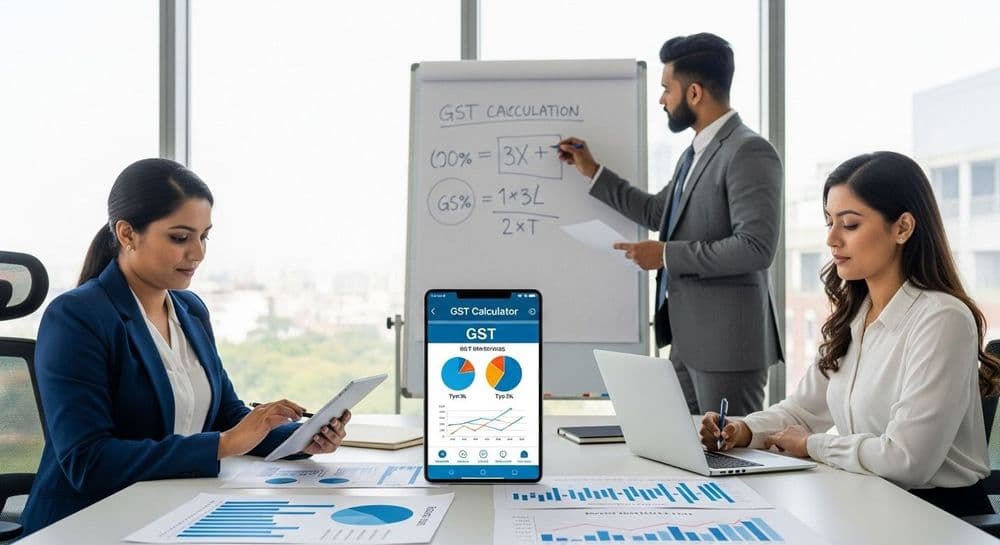
A GST calculator is a vital online tool for both businesses and consumers, aiding in the calculation of GST obligations. Whether you are a retailer, wholesaler, or consumer, this tool streamlines the process of determining the GST owed on a transaction, enabling accurate pricing and budgeting. For further insights on effective financial planning, refer to our guide on MSME Registration Process in India.
How to Calculate GST?
Calculating GST is straightforward with the appropriate formulas. Here’s how:
If the price is exclusive of GST:
- GST Amount = (Value of Supply x GST%) / 100
- Price to Charge = Value of Supply + GST Amount
If the price is inclusive of GST:
- GST Amount = Value of Supply – [Value of Supply x {100 / (100 + GST%)}]
Example of GST Calculation
For example, if an invoice total is ₹100,000 and the applicable GST rate is 12%, the GST payable would be ₹12,000, leading to a total invoice amount of ₹112,000.
Manufacturer's GST Calculation
- Cost of Product: ₹200,000
- Profit Margin (10%): ₹20,000
- Excise Duty (12.5%): ₹27,500
- Total Pre-GST: ₹247,500
- Final Invoice to Wholesaler: ₹278,438
Retailer’s GST Calculation
- Cost of Product: ₹278,438
- Profit Margin (10%): ₹27,844
- Total Pre-GST: ₹306,282
- Final Invoice to Consumer: ₹313,629
How to Use a GST Calculator Online
Using a GST calculator is simple:
- Input Details: Enter the net price of the good or service along with the corresponding GST rate.
- Calculate: Click the ‘calculate’ button to see the breakdown of tax amounts for CGST, SGST, or IGST, along with the final price.
Components of a GST Calculator
Key features of a GST calculator include:
- GST Rate Selection: Choose the correct GST rate applicable to the goods or services.
- Value of Supply: The amount at which goods or services are sold or purchased, excluding GST.
- Automatic Calculation: The tool automatically computes the GST once the taxable value and GST rate are entered.
In conclusion, grasping the nuances of GST is vital for anyone involved in business or purchasing goods and services in India. Utilizing tools like GST calculators can significantly enhance financial planning and compliance, fostering a more efficient marketplace. For those interested in optimizing their business setup, explore our AI-Powered Legal & Business Services for comprehensive support.
Frequently Asked Questions
What is the purpose of Goods and Services Tax (GST) in India?
Goods and Services Tax (GST) was introduced in India on July 1, 2017, to streamline the taxation system by consolidating various indirect taxes into a single framework. The main purpose of GST is to make the tax structure more efficient and transparent, ensuring that tax is collected at the point of consumption rather than at multiple stages of production and distribution. By reducing the cascading effect of taxes, GST aims to lower the overall tax burden on consumers and businesses, encouraging compliance and improving the ease of doing business in India.
What are the different types of GST in India?
In India, GST is categorized into four primary types: Central Goods and Services Tax (CGST), State Goods and Services Tax (SGST), Union Territory Goods and Services Tax (UTGST), and Integrated Goods and Services Tax (IGST). CGST is collected by the central government on intra-state sales, while SGST is collected by state governments on the same transactions. For transactions occurring in Union Territories, UTGST applies. On the other hand, IGST is levied on inter-state sales, facilitating the movement of goods across states. Understanding these categories can help businesses comply with tax regulations effectively.
How can I calculate GST on my purchases?
Calculating GST on your purchases is straightforward. If the price is exclusive of GST, you can use the formula: GST Amount = (Value of Supply x GST%) / 100. Then, to find the total price, simply add the GST Amount to the Value of Supply. If the price is inclusive of GST, the formula changes to: GST Amount = Value of Supply – [Value of Supply x {100 / (100 + GST%)}]. For example, if a product costs ₹100,000 and the applicable GST rate is 12%, the GST would be ₹12,000, making the total ₹112,000. Familiarizing yourself with these calculations can help you budget better.
What is a GST calculator and how can it help me?
A GST calculator is an online tool designed to simplify the process of calculating GST for both businesses and consumers. It allows you to input the net price of goods or services and the applicable GST rate, and it automatically computes the GST amount and the final price. This tool is especially useful for retailers and wholesalers who need to ensure accurate pricing and compliance with tax obligations. By using a GST calculator, you can save time and reduce the risk of errors in your financial planning, making it an essential resource for anyone involved in transactions subject to GST.
What are the benefits of using a GST calculator?
Using a GST calculator offers several benefits. Firstly, it streamlines the calculation process, saving you time and effort, especially if you're dealing with multiple transactions. Secondly, it reduces the likelihood of errors in your calculations, which can lead to compliance issues or financial discrepancies. Additionally, a GST calculator provides a clear breakdown of CGST, SGST, or IGST amounts, helping you understand your tax obligations better. Ultimately, this tool aids in effective financial planning, ensuring you're not caught off guard during tax assessments and enabling you to manage your pricing strategies more efficiently.
Start Your Business Today
Complete company registration with expert guidance